
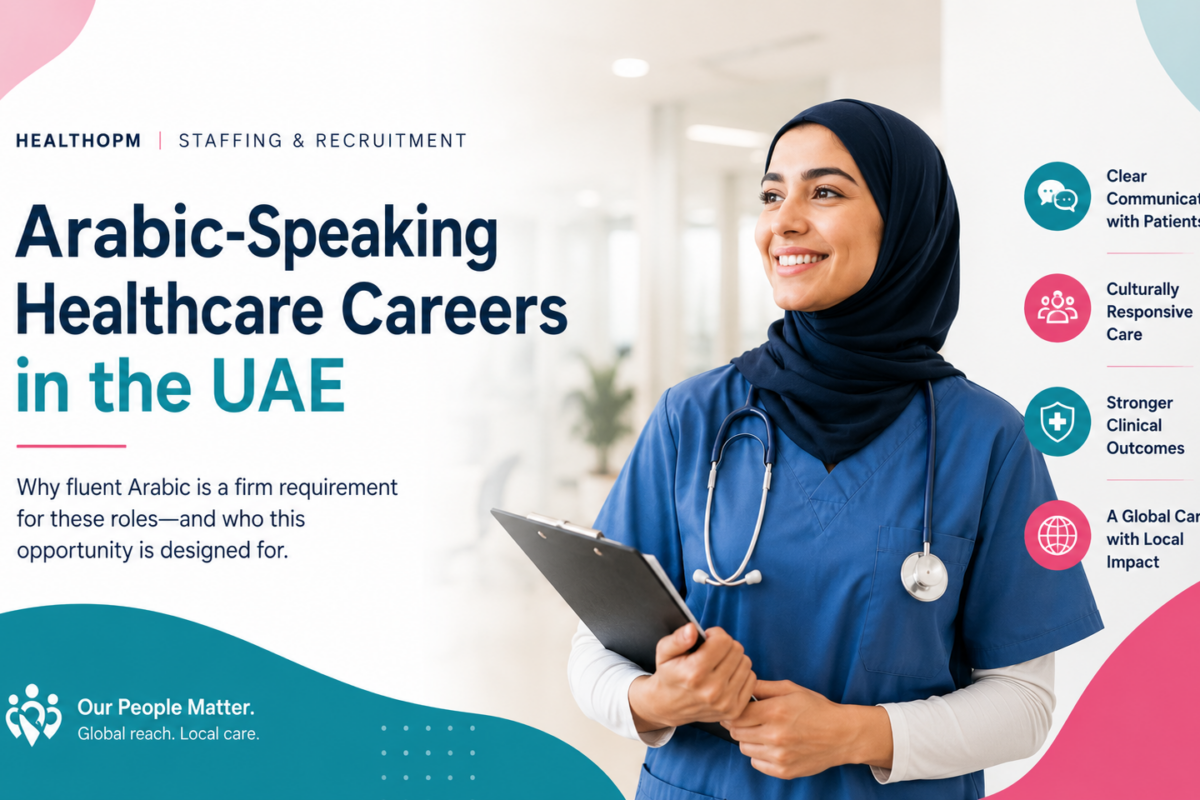
Arabic-Speaking Healthcare Careers in the UAE: Why Language Matters

Fluent Arabic is one of the most consistent requirements across international healthcare recruitment in the UAE — and it’s a hard requirement in HealthOPM’s current openings, not a preference listed alongside a dozen “nice to haves.”

Why Employers Require It

Clear, direct communication with patients and their families is central to safe care in any clinical setting. In the UAE, that often means communicating in Arabic — not through an interpreter, and not only in written documentation. For roles like Clinical Psychologist and Consultant Psychiatrist, where accurate communication is part of the clinical work itself, this isn’t a formality.

Who This Typically Fits

Bilingual healthcare professionals trained in Canada or the US — whether they grew up speaking Arabic at home, studied it formally, or built fluency through family or community ties — are often an unusually strong fit for these roles, precisely because that combination of Western clinical training plus fluent Arabic is less common than either skill on its own.

What “Fluent” Means Here

There’s no universal test score required across all UAE healthcare employers, and requirements can vary by role and employer. For HealthOPM’s current openings, candidates should be comfortable conducting clinical conversations, documentation, and patient interactions in Arabic, not just casual conversation.

This Requirement Applies Across All Four Current Roles

Registered Nurse, Clinical Psychologist, Consultant Psychiatrist, and Practical Nurse (LPN) — fluent Arabic is required for all four current openings.

Next Step

If you’re a bilingual healthcare professional considering a move abroad, review the specific role that matches your background, or read our overview of the broader UAE recruitment path.

UAE Healthcare Careers for Canadian and US-Trained Professionals

If you’re a Canadian- or US-trained healthcare professional considering work abroad, the United Arab Emirates has become an active market recruiting internationally trained nurses, psychologists, and psychiatrists. This guide explains what that path typically looks like, what to expect, and where HealthOPM’s current opportunities fit in.

Why the UAE Is Recruiting Internationally Trained Professionals

Healthcare systems across the Gulf region, including the UAE, have expanded significantly over the past decade and continue to recruit clinicians from outside the region to meet demand — particularly in specialties and language combinations that are harder to fill locally. For Western-trained professionals, this has created a genuine, if competitive, pathway into international practice.

What “Arabic-Speaking” Roles Usually Mean

A number of current opportunities, including the four HealthOPM is recruiting for, specifically require fluent Arabic in addition to clinical qualifications. This isn’t a soft preference — it reflects the day-to-day reality of communicating clearly with Arabic-speaking patients and families in these settings. If you’re bilingual and trained in Canada or the US, that combination is a genuine point of differentiation. Read more in our Arabic-Speaking Healthcare Careers guide.

The Four Roles HealthOPM Is Currently Recruiting

  • Registered Nurse — hands-on clinical care in a rehabilitation and detox setting
  • Clinical Psychologist — assessment and evidence-based treatment for adults
  • Consultant Psychiatrist — a senior clinical leadership role helping build a new psychiatric service
  • Practical Nurse (LPN) — patient care under RN and clinical supervision

Each role has its own licensing, education, and experience requirements — see the individual job listings for specifics.

What the Process Generally Involves

Working in the UAE as a foreign-trained healthcare professional generally requires clearing a regulatory eligibility and licensing process through the relevant health authority for the emirate you’ll be working in. This typically includes credential verification and a review of your education and experience against the UAE’s Professional Qualification Requirements. Requirements vary by profession and by individual credentials, and eligibility is decided by the regulatory authority — not by HealthOPM. Our DOH Eligibility & Licensing Guide covers this in detail.

What to Expect From Relocating

Moving internationally for a two-year contract is a significant decision, and the details — visa sponsorship, any relocation assistance, and family considerations — vary by role and are confirmed directly with shortlisted candidates rather than promised upfront. Our relocation guide walks through what to realistically expect before you apply.

Is This a Fit for You?

These roles are aimed at Western-trained professionals who:

  • Hold, or are eligible for, a professional license or registration in their current country of practice
  • Have relevant clinical experience in their field
  • Are fluent in Arabic
  • Are genuinely open to relocating internationally for a two-year contract

No Fee to Candidates

HealthOPM does not charge candidates a recruitment fee at any stage of this process. Our recruitment process guide explains what happens after you apply.

Next Steps

Explore the current openings, or start with whichever guide answers your most pressing question — Arabic requirements, DOH licensing, relocation, or our recruitment process.

Why Strong Healthcare Staffing Matters

Healthcare is at the core of every thriving community. It ensures that people whether they are seniors in long-term care, patients in hospitals, or residents of supportive housing,  receive the compassion, attention, and expertise they deserve. But behind every positive patient experience lies something less visible yet equally critical: strong staffing solutions.

How to Retain Nurses in Long-Term Care and Retirement Homes

Retaining nurses in long-term care (LTC) and retirement homes isn’t just about keeping the lights on—it’s about maintaining continuity in care, supporting patient well-being, and running an efficient healthcare operation. Staffing challenges are real in the healthcare industry, and as a staffing agency, we know first-hand that employee retention is key to solving workforce shortages and keeping facilities running smoothly.  Here are a few actionable strategies to retain nurses and create a positive work environment in LTC and retirement homes.

Top 10 Qualities of a Nurse: A Guide by HealthOPM

Nursing is a profession that demands not only technical skills but also a deep commitment to patient care. As one of the leading healthcare recruitment agencies in Canada, HealthOPM recognizes the essential qualities that make nurses exceptional in their roles. Whether you’re considering travel nursing through agencies or seeking placement through a recruitment agency, these qualities are what top employers look for.

Here are the top 10 qualities every outstanding nurse should possess: